
Abstract
If this report has reached you, then you already know everything written here; thus, this report is not a research or notification report. For the same reason, it was not written to contribute to any type of human accumulation. Ultimately, these negations show that this report was not written for itself but was written for a purpose that it too could serve. And if it reaches its goal, it will have completed its mission.
We are in need of saying what we will say last, first. Because we know we will not bring new news, and therefore, through the reflexive perspective that the writing purpose of this text, which we will now directly inform the reader, can provide, we hope to remind the reader of the things written here as an excuse for remembering and thus bring the “novelty” of being alive and active. Because this letter, which does not exist for itself and is written from one Muslim community to another, reminds us in a very urgent composition of the experiences of Syrians who have sought asylum in our country and their conditions, the situation in our Muslim country, Turkey, and says: “If these were the roles and responsibilities left to us by the history written by Allah, then we are failing our test.” The message continues: “…Perhaps as a society, you too are responding to this issue within yourselves with publications or direct action. But we have no doubt that the racism program directed at Syrians, which reached its strongest form with various programs organized by different people in the country during the May 14 election period, then hibernated after October 7, and is currently resting in a taqiyya form, is a host virus organism waiting for the moment to find a new living object in the upcoming historical strip, if we do not intervene and be there before it.”
We, who felt the need to deliver this report to you, even if we have strived to solve these problems to the extent our resources allowed, after October 7, while witnessing the struggle of Hamas and the Palestinians once again, under the obligation to somehow declare our side in this war on their side and in our attempts to express ourselves as Muslims, found ourselves in the possibility of meeting various Muslim friends and uniting with them, and with this opportunity, we found within ourselves a belief in the idea of various Islamic formations coming together for action with more peace and greater confidence than ever before. Perhaps, therefore, maybe with the breeze of feeling this belief, we suddenly found the idea of conveying these words ready within ourselves. This report is trying to fulfill the requirement of this belief.
We have prayers for more than what we can do. And finally, our message to the reader will be: Organize a meeting about the issue of Syrians in our country and invite all civil society organizations involved in this issue, including us, to this great meeting. We are ready to take on a responsibility assigned to us in this bigger, stronger, more accurate organization. But let’s do whatever we do together, and let it be before racism awakens from its sleep.
These are all the desires of this message.
1. Introduction
(Note: You can access the source code for the graphics in this section via this link.)
We are talking about a problem that has existed since 2013. So why is there a need to talk about this problem in 2024?
Various analyses conducted with different methods on perceptions before 2020 (Topal et al., 2016; Topal et al., 2017; Öztürk et al., 2018; Aslan et al., 2019) showed that in Turkey, positive impressions towards Syrians were more than the negatives, while the results of studies after 2020 (Karaman, 2022; Parlak et al., 2023) showed that the statistics of negative judgments in perceptions were more than the positives. Therefore, before even the results of the studies, what drew a researcher’s own perception to this change was likely the primary experiences making this result evident in observation. Thus, over time, we could think that racism was directly proportional to the fluctuation of the dollar, even though this graph would be incorrect since the measurement methods in the compared studies were not the same,
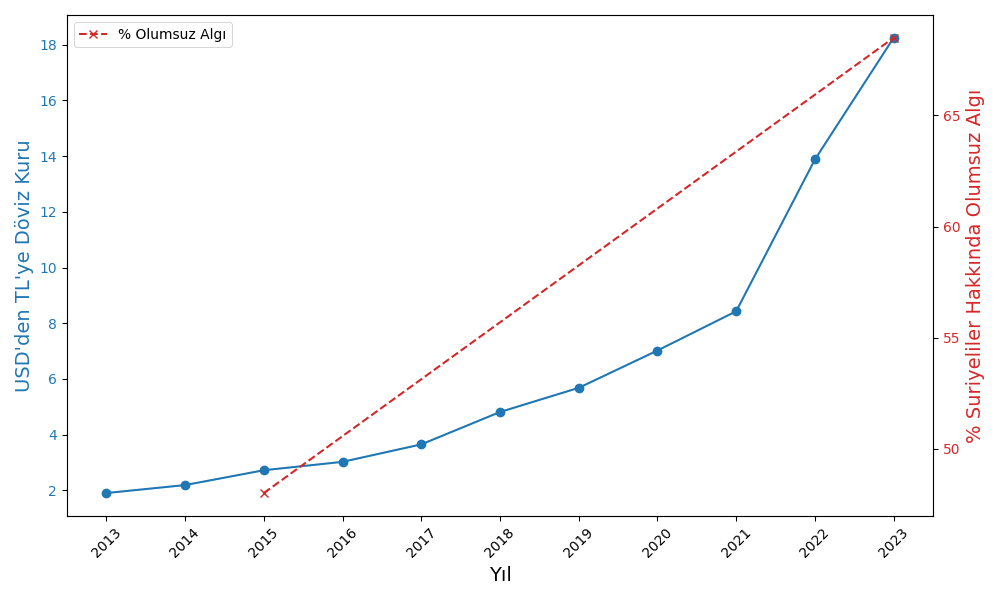
However, to establish an indirect correlation between these two, despite there being little evidence of the exclusion of the local population in labor markets (Akgündüz et al., 2015), it is necessary to mention that Syrians have negative effects on the economy (Türkan, 2017) or that they inevitably have negative consequences in the Turkish economy, inflation, and housing prices in the long term (Kaya et al., 2021; Akgündüz et al., 2015). In this case, we would have to accept that the relationship that makes the above graph correct is a deterministic law causing people to be racist, a survival instinct. And if we want to somehow bring this problem back to balance –even if not to an absolute solution, as before– we need to consider these deterministic laws.
However, these favorable conditions only represented the host cell that allowed the virus to reach its living form. Because those who refer to “politics is the art of the possible” must have known from the political history of states that quickly finding a response to the program of excluding immigrants –because it is easier, thus more feasible– would be quick. Under these conditions, the virus found a host for itself. Thus, the fluctuation of the dollar was not initially in direct strong connection with racism; but those who prepared a “feasible” political program must have thought it possible to deport Syrians, thus they presented them as the sole independent variable of the dollar’s fluctuation. However, the dollar was only a variable representing the commodity, i.e., the deterministic demand of society. And whenever the demand for social benefit increases –just like in the pandemic (Koytak et al., 2023)– people could target immigrants. Because clearly, this deterministic drive always –and especially in human disasters, i.e., when situations become difficult and being virtuous becomes even harder–, suggests excluding “those who are not inherently entitled to life” -these immigrants- if they have even a slight share in the distribution of resources or if this distribution is even a possibility, they suggest excluding them.
In this case, the dollar only becomes a catalyst. And the real factor of the reaction is always there, looking for another reactive. Because if there is no doubt that Syrians did not start the pandemic and there are fluctuations in racism even at such a time, then the initial claims need to be reviewed. This leads us to the racism program that is always looking for a new object and will continue to find one. Just like a pandemic virus, which is a deterministic law: Fast, effective, and contagious. Because even if a person is not entitled to life, this only shows that they are not entitled to life; thus, even if deporting immigrants would improve the living conditions of citizens, the fact that the right to immigrate is not in the immigrants’ control takes away the “legitimacy” of hating them from the citizens. Therefore, the tendency of anger in the rhetoric of the racism program trying to present itself as an economic program reveals the purpose of this program within its own language. And this leads us to various forms of implementation/execution of the racism program towards Syrians in Turkey (Yılmaz et al., 2023; Taşğın, 2020). What this report wants to underline, and what we know will coincide with the reader’s own primary and obvious experience, is that although this relationship is a complex one dependent on various variables (Tumen, 2023; Kınıklıoğlu, 2020), the observed reality, especially with the conducted racism program, is the fact that the negative perception of the Turkish people towards Syrians has increased.
Some studies show that the Nation Alliance voters display more discriminatory attitudes than the People’s Alliance voters (Bandúr, 2020), some show that positive attitudes stem from religious motifs but personal economic concerns can overcome these factors (Morgül et al., 2021) or that these frameworks generally do not suffice to maintain positive attitudes, some show that political rhetoric directly affects perception (Alakoc et al., 2021), and some show that attitudes towards Syrian refugees have become highly politicized in recent times (Gökçe et al., 2021). Everyone associates this with various variables in society. But whatever the reason, a century ago, while Turkey was a country of exile, now for a Syrian, Turkey is what France is for an Algerian. And then, for whatever reason, no reason makes it impossible for us to accept racism as legitimate. But ultimately, this fact belongs to Turkey.
All secondary factors contribute to the main reason, which is perception. And perception does not accept sudden interventions. It simmers slowly in the pot. From this perspective, even in our small circle, we had seen the effects of this wave. After the May 2023 elections, even if the party running the immigrant/racism program was not elected, the impressions left in the public sphere by its effects and the new expectations of the public after this change in perception were met not only with a negative social atmosphere but also with interventions by the political will. This shows us that in the historical strip of Turkey, anti-immigrant parties, despite the complexity of the relationships involved, can actually use this complexity to their advantage to establish a direct proportion between the public’s perception of Syrians and their living conditions, especially since the immigration program will be politically divisive/determinative, convincing the public for their campaign –in favor of their own immigration program– by amplifying the societal response to this fact with their negative rhetoric, thus affecting the perception of Syrians in all fluctuations. So much so that the public’s belief in a non-existent problem will always create a new problem, showing that the owners of anti-immigrant rhetoric will “win” some things even if they lose. That is, Syrian immigrants will always have something to lose.
Therefore, unlike in 2013, in 2024, we look back on the first decade of the Refugee Issue in Turkey and follow its movements. No matter how prosperous the society is, its demand for social benefit will find a new object, leading us to think that the immigrant issue will only manifest in different forms; without talking about bringing this problem, as old as human history, to an absolute solution, we hope to bring it to a balance within society. Our hope is because we are not the only ones hoping for this. And our suggestion is directed towards the cooperation of all parties, considering the fact that there are real and legal entities working on this issue in Turkey.
The immigrant issue is now (and has long been) a fact of Turkey, and if nothing is done in response to this perception –regardless of the relationship with the dollar or any other object of benefit– the negative perception will inevitably increase in connection with another object, as shown in the graph above. We believe that even in a scenario where the elections result “in favor” of Syrians, the outcomes brought about by the negative perception will inevitably create results against them. This necessitates, in our opinion, the cooperation of stakeholders in an anti-program that can create a counterweight to the negative perception program –predicted to continue in different forms in the future– and serve the positive perception. If this nuanced program is not started in advance, just like in the May timeline, the field of activity of civil society will only serve to mitigate the bad outcomes brought about by this negative perception –like going to help after a war, not in a war. But this civil society is very strong with its resources and will, and perhaps the issue will be in solving the idea of Islamic formations coming together for action.
This report has already communicated all its messages in the section so far; from now on, as a requirement of its reminder function, you will find presentations of various Syrian examples of different ages living in Turkey, sometimes related to numbers in classifying methods and sometimes focused on the uniqueness of each, some related to the threshold of May 2023 and some indicating a general situation.
2. Impressions
(Note: You can access the source code for the outputs in this section via this link.)
We want to report an image. The first criticism that can be brought to a focus prepared to show a known image is that it is guided, of course; but an orientation is already guided towards the direction it is oriented, and every perspective has a focal point after all. Therefore, even if it were a study encompassing all possible inferences, this research would necessarily be guided to some place. That’s the first point.
Secondly, we know various images, but we specifically want to see an image. Therefore, since encompassing other inferences and situations was not our initial goal from the start, we want to highlight an image suitable for the theme of this report’s announcement. This image is, of course, about the pains of Syrians, which are clear in our primary experiences. And whatever happens, since pain is the most real thing, another focus showing this from a perspective could not be directly of interest to us.
Ultimately, something could also be said against Syrians –or against all other immigrants encompassed by the homogenization of the bad, i.e., the outside, under the name of Arabs– and this issue could be looked at as an integration issue in its entirety. Indeed, it was an integration issue that worked against both sides. But just like the situation that transformed Yesrib into Medina, it could also give rise to a process that worked in favor of both sides. It hasn’t happened so far, but it hasn’t ended yet. Thus, it has become the issue of Turkey and us. “For a while.”
2.1 Surveys and Statistics
(Note: You can access the prepared research surveys via this link.)
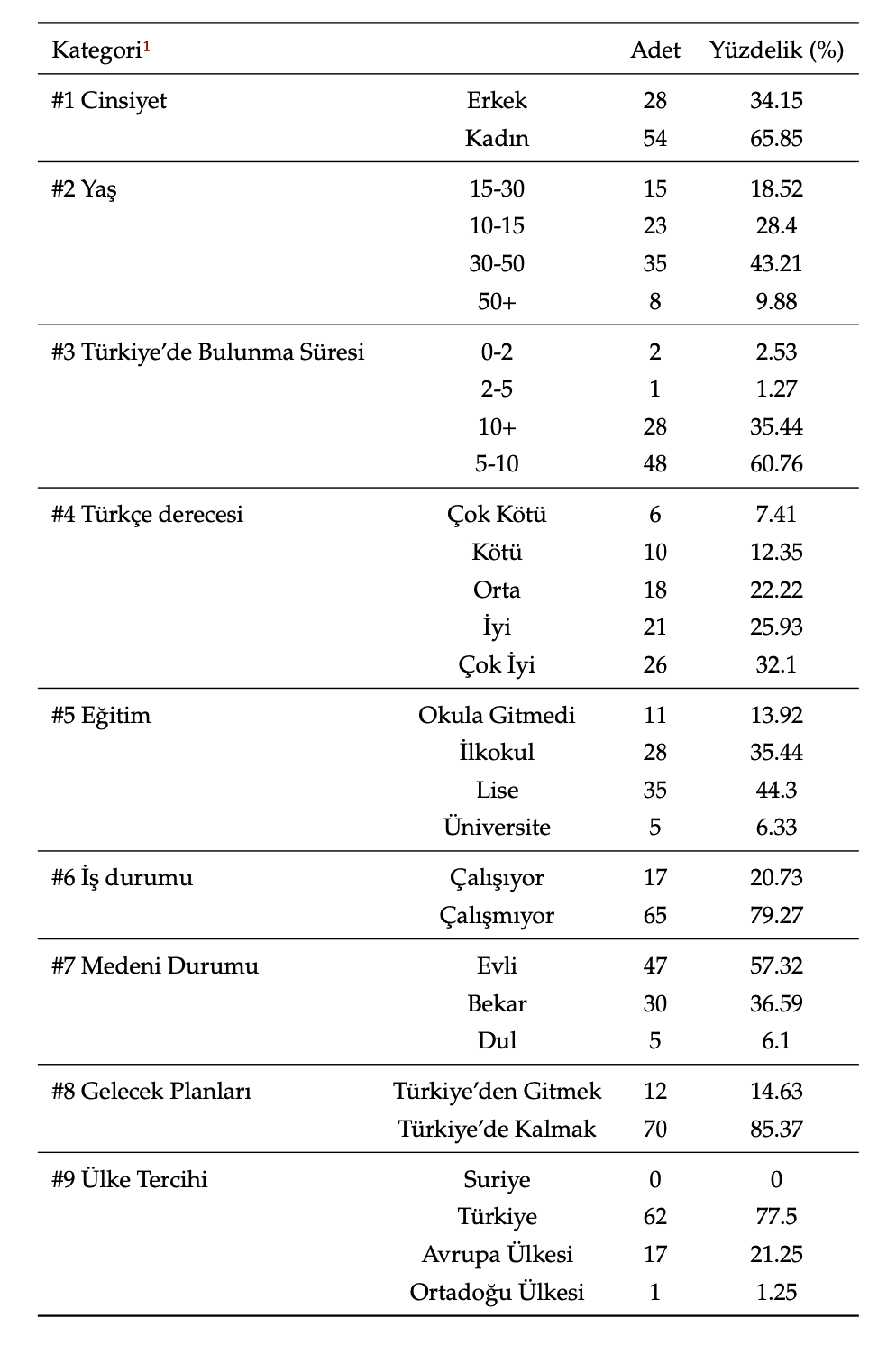
Frankly, as one of the followers of this research, it also becomes apparent to us in this distribution, which first defines the group and then gives the initial impressions: No one wants to return to Syria. This is because even after times when we could think that a small migration wave was triggered reactively to the tightening of identity-less immigrant controls during the May period, and the public’s expectation of mobility, we did not think that the idea of Staying in Turkey or having another choice would be so strong for them. Therefore, this thought puts a question mark next to the temporariness of this situation once again.
Later on, if we were in the execution of a method, but more so a method aimed at understanding and solving, a category matrix could be drawn up, for example, to evaluate some correlations between characteristics,

Thus, within the group itself –not related to our topic– many correlations emerge, some of which are obvious and natural, hence insignificant, such as the various meanings between the age category in warm regions (#2), marital status (#7), or employment status (#6) when we look at the matrix; some are things that could be indirectly related to the topic, for example, the relationship between the Turkey experience and the future plans of Syrians,
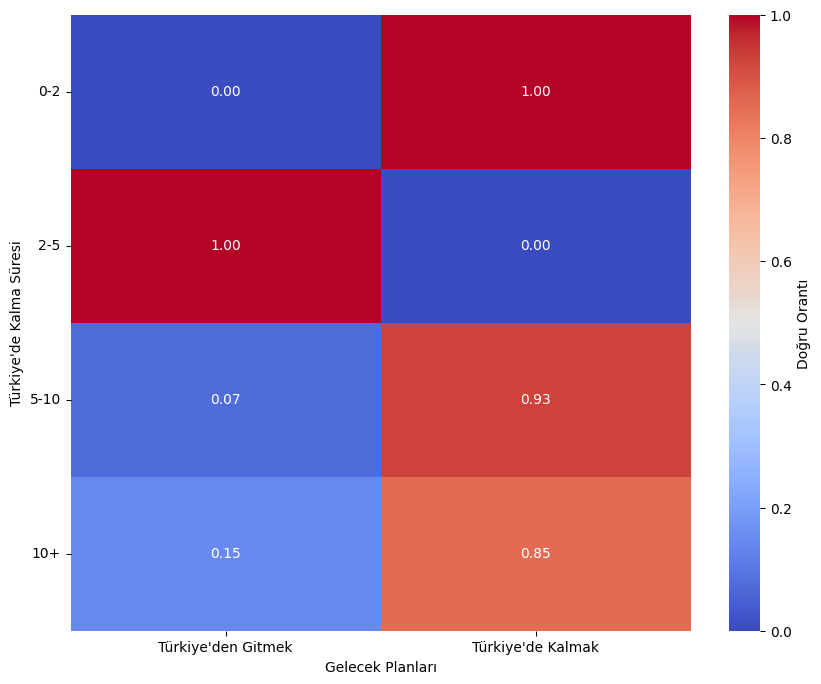
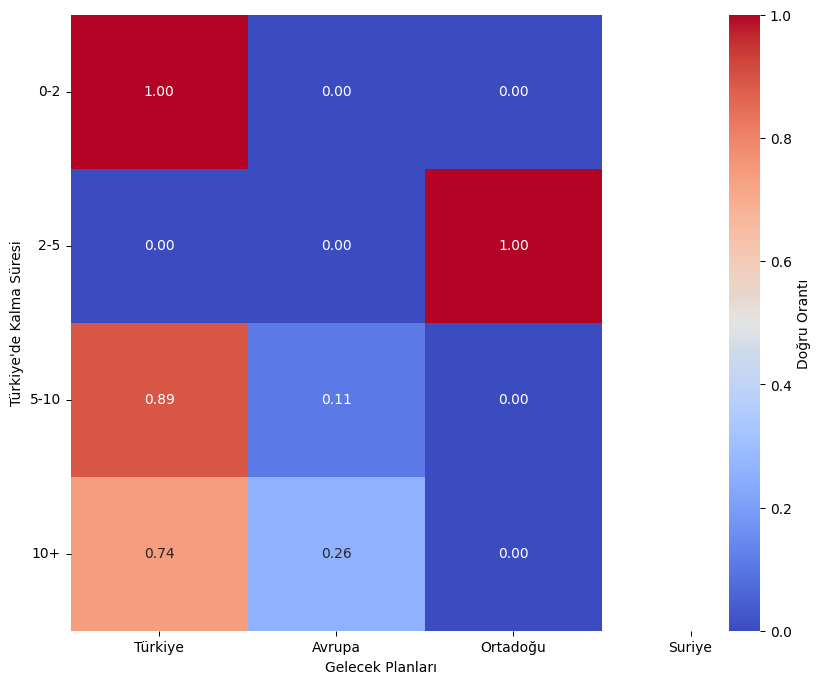
Here, the obvious meaning is this: The experience in Turkey reduces the desire to stay in Turkey. And the small size of the sample space may have caused jumps on this direct proportion line. Thus, judgments like “Someone who has just come to Turkey wants to stay in Turkey.” or “If a newcomer (0-2 years) absolutely did not want to stay in Turkey or mostly wanted to leave Turkey, in this case, we could attribute a meaning to this movement related to Turkey being used as a transit to European countries.” remain suspended.
As we continue with various questions, the following relationship emerges,
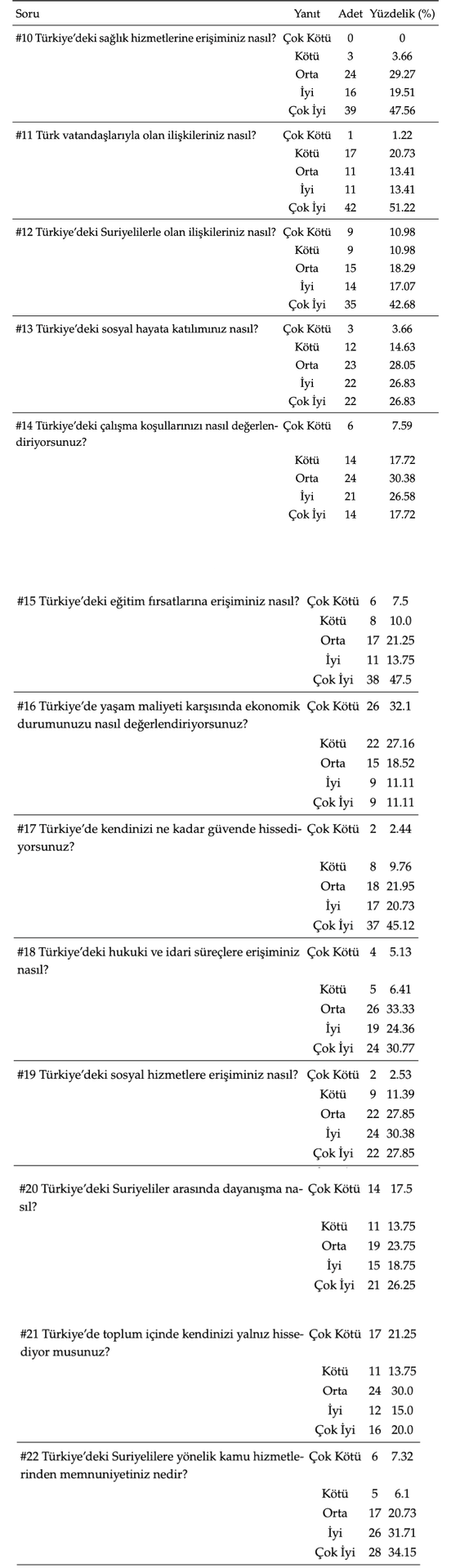
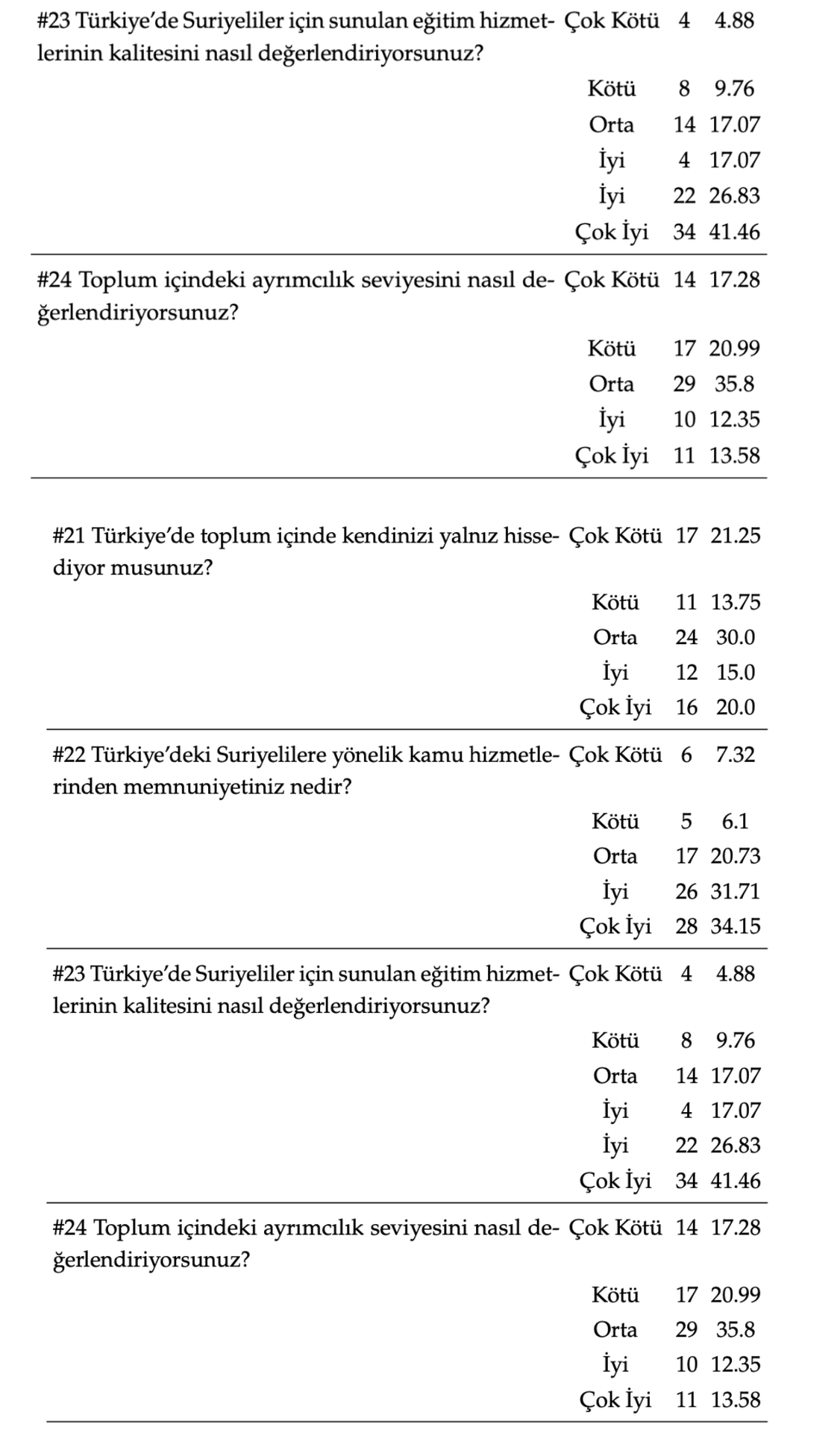
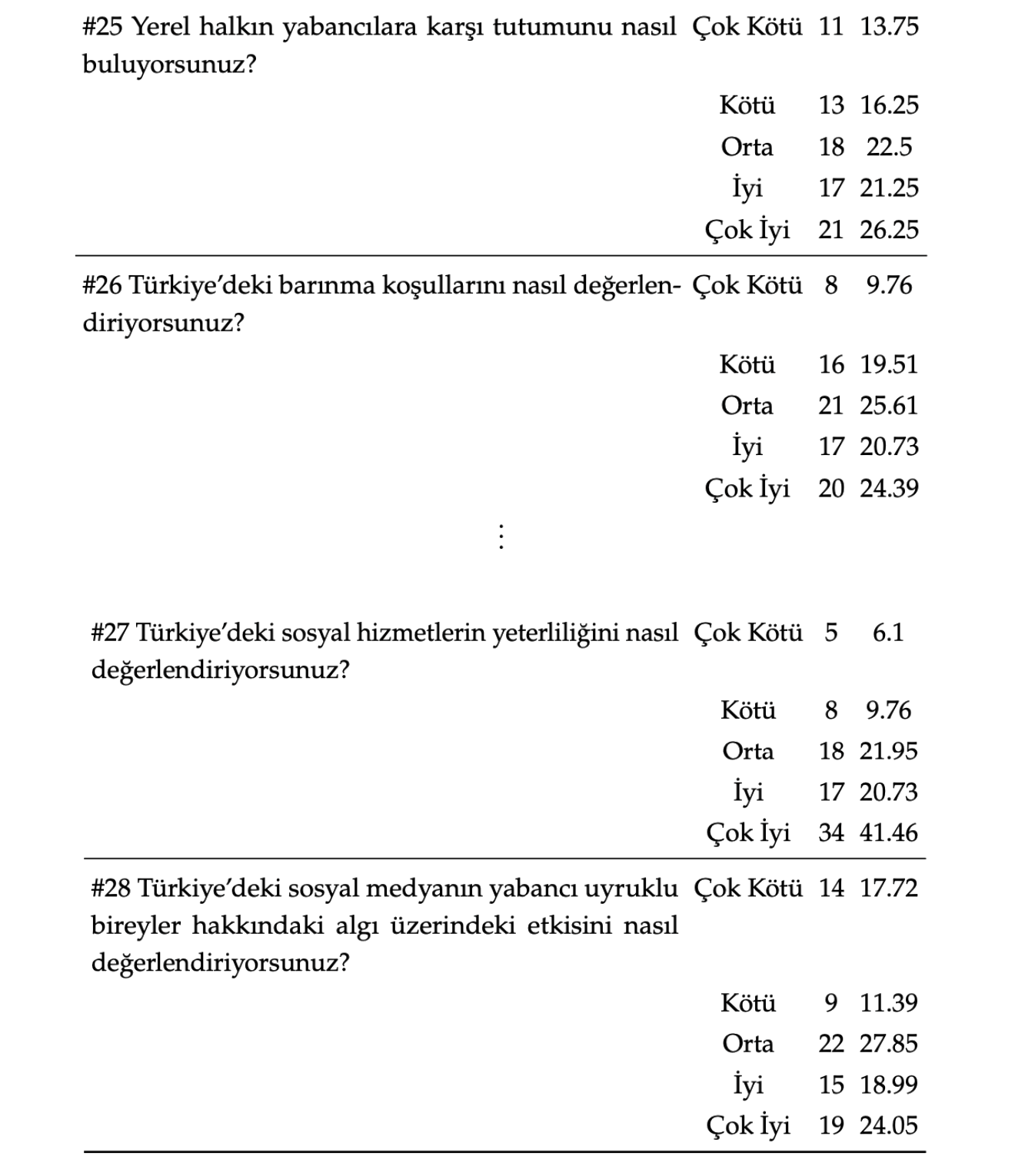
Without examining these categorical and score-based results together, for easier understanding, we need to classify them starting from the initial categories, and for this, before feeding the data into various classification methods, we now need to fill in some responses that were left blank and not included in the statistics of the survey: After columns with numeric data (#10-#28) were normalized, missing data imputation was done based on the median of the series. The processing of categorical data was done according to the mode of the series. To visualize the classes, dimensionality reduction was performed using the PFA method, and then the data was divided into 3 classes according to these reduced dimensions using the KMeans method.
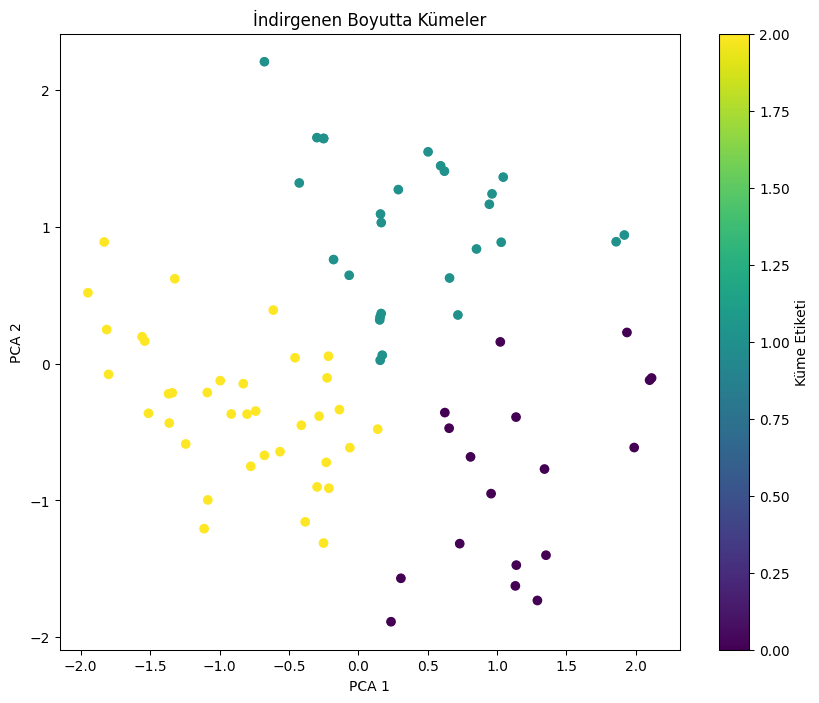
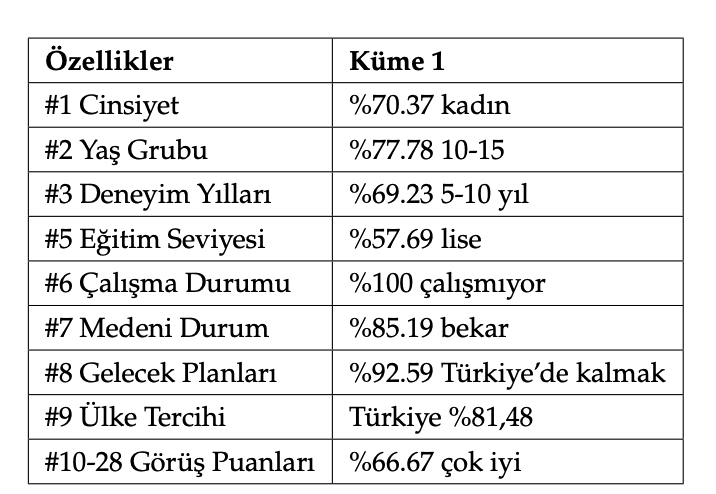
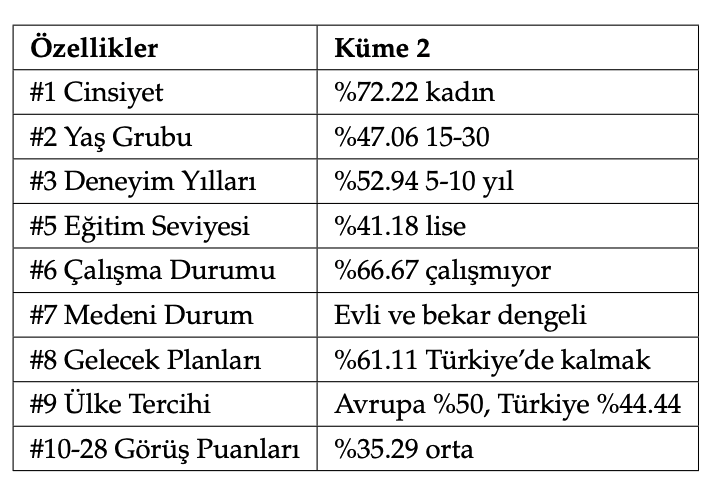
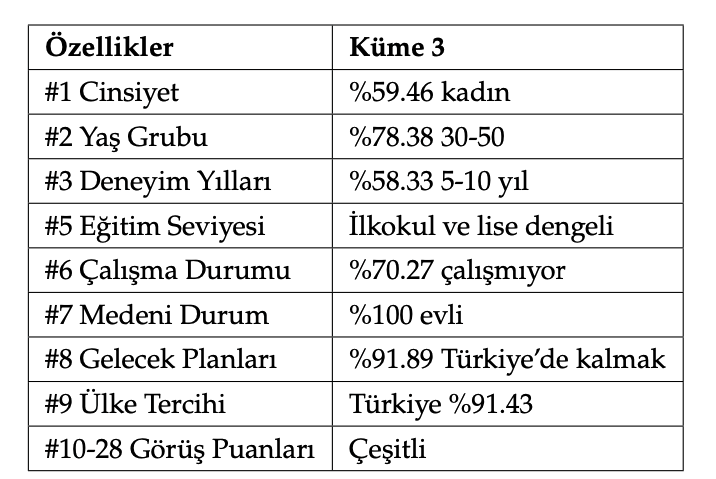
We see that the classifier primarily captures a distinction in the Age category, possibly preceding a clustering at a certain point in other responses. And it turns out that the views of the younger population are optimistic. From this point on, this optimism decreases in a straight line in other clusters. The interrelated connections within the data do not directly enter our topic, so we try to present the data in a more understandable focus only.
These results give us a first impression about their perceptions. For example, in question #27 (social services), the perception of the majority appears optimistic (41.46%). This question type is actually an example of its kind, questions about social services, and as in the response given to it, despite minor fluctuations, we see optimistic results in the responses to this type of questions in their perception. However, when we accept this perception as an authority for making an inference, these tables only show us that the integration issue, in this leg of it (i.e., the social services leg), is not entirely unsuccessful. And while the same pattern continues in questions about these types of services, we see fluctuations in the responses to questions about the perception of Turks (For example, #24, Very Bad: 17.28%, Bad: 20.99%, Medium: 35.8%, Good: 12.35%, Very Good: 13.58%). Of course, we do not see an overwhelming majority, but unlike questions about social services, we definitely see clustering towards medium or bad in perception-oriented questions (#24, #25, #28, etc.)
Solving the problem is of course a more delicate task than defining it. Because solving the problem first and foremost requires a condition of better understanding the problem. On the other hand, identifying the problem, that is, discovering that there is a fundamental problem, is not considered a less delicate task. Therefore, claiming to understand the problem is a claim; but we use our preference to identify the problem here: In the end, one of the results, where inference is not made with a great force/interpretation in these examinations that also touch on various secondary relationships, is that the overwhelming majority’s future plan is to stay in Turkey, and the other is that optimism is not only visible in questions about perception –directed towards them. In light of these impressions, we reiterate the thought from the first section that some of the resources –now emerging as a more fundamental problem of this integration issue– need to be allocated to the problem of the negative perception of the Turkish public.
2.2 Individual Responses
We can show the following if some individual responses will open a more humane impression,
#29 What difficulties have you experienced in Turkey?
– I am not experiencing any difficulties.
– A bit.
– I have no difficulties.
– Constant mocking.
– Excessively high prices.
– There is a lot of racism in Turkey.
– Some Turks are very racist against Syrians.
– Difficulty in understanding.
– Very good.
– Thank God, I have not encountered any problems.
– Everything is about racism.
– A difficult life.
– I don’t know at all.
– The difficulty of covering living expenses and needs.
– Instability.
– Instability and difficulty in living.
– Behaviors.
– Discrimination.
– We see too much discrimination.
– Agreement.
– No difficulties other than the difficulty of living.
– I am not experiencing any difficulties.
– Language.
– None.
– We barely find jobs.
– None. I am very happy.
– Traffic congestion.
– Struggle of life.
The length of this publication here has been shortened, the rest of the content can be accessed from the downloadable link at the bottom.
2.3 Interview
(Note: Many sentences in the dialogue have been translated as closely as possible to preserve the meaning’s manifestation in the dialogue. However, some nuances of spoken language that do not serve the meaning have been removed for readability and orderliness. You can access the original video of the dialogue from this link.)
– How were you living before the war? How did you start living after the war? How did you live after your husband died?
+ Before the war, thank God, our life was very good. And it was beautiful. But the war took everything away, my husband became a martyr. May God have mercy on him. He was going to the Isha prayer when a bomb fell and he died along with 5 others. May God accept them. My husband died, may God have mercy on him. My eldest child is 13 years old.
– How many children do you have?
+ 5 children.
– Did he pass away during Ramadan?
+ Yes, in Ramadan. This is my children’s story, thank God. My eldest son had just turned 16. Our financial situation worsened, so I had to send him to Turkey. And thank God he went, started working there. He began to support us. Life was very difficult because of the war in Syria. 5 years after my child went to Turkey, the situation here started to get more complicated. This place began to be hit more. And our house here was bombed, not just our house but many places were bombed. People didn’t understand how they saved themselves from the rubble. It was a night without morning. And we left in the pitch dark, I don’t know how we left but thank God we survived. We migrated to Afrin, stayed there for three years. And three years later, problems started there too, our financial situation worsened. Really, life in Syria was very difficult. And we had to go to my son. My child borrowed money, we accumulated debt and had difficulty leaving.
– Who did you go with? All your children?
+ Me and my children. Of course. With my 2 daughters and 3 sons. As I said earlier, my eldest son had already gone. And thank God we went with the ones who remained.
– Before you left, after your husband died, how did your life continue? How were you living and then how did it continue? How did the news reach you? How was your day?
+ Subhanallah.
– What were you doing that day?
+ We were sitting. My husband was going to the Tarawih prayer.
– After Iftar?
+ Yes. After Iftar. In the days before my husband left, bombs and missiles were already falling. We were always in fear and stress.
– I knew my husband went to prayer. Subhanallah, that day bombs fell on our street too. And we received the news, we heard that the missile fell on the neighbors. Subhanallah, half an hour later the news reached me. After this news, me and my children experienced the disaster. May God have mercy. Alhamdulillah for every situation. And as I told you, we went to Turkey. I came to my children, thank God we reunited. My children are very young. Thank God me and my children work. And Subhanallah. When we arrived here, we had neither identity nor anything. Situations were very difficult. Even if I wanted to get IDs at first, I couldn’t afford it. Secondly, they don’t allow identification with fingerprints. And after living in Turkey for a year, after situations improved, God willing, we start to strive for IDs. Even 6-7 months after we arrived, we were still afraid and anxious when going out to buy anything, fearing being caught and sent back to Syria. If we were sent back to Syria, it would be very bad for us. You know the situation in Syria, especially now. And once, they came to us. They knocked on the door and entered.
– Could you repeat that? Can you tell the story of Ahmet?
(Here, she hesitates and does not continue.)
– Relax, tell more details. Don’t rush. You’re skipping very important details.
+ It hurt me.
– You’re telling people the end of your story. They won’t understand anything.
– We came out to Turkey. My youngest son started working with his brother. We looked for jobs but were afraid because we had no IDs. My youngest son started working with his older brother. They started going back and forth together. My daughter lives with me along with her children. My daughter has 2 small children. They took my 17-year-old son and sent him to Syria.
– Were they caught?
+ They were caught and sent to Syria. We experienced this incident here and really felt sorry for him. As we told you, we struggled a lot to come here. We borrowed money and accumulated a debt of 10,000 dollars. Until we rented and arranged a house, our debt became 12,000 dollars. And five days after we sent my son, they came to our house. They knocked on the door, stormed in. Subhanallah, they all entered armed and in armor. And here, we remembered our situation in Syria. It was like that. They took us away. First, they asked for IDs. Then we said we didn’t have IDs and that we had just arrived. They asked where your husband is. I said my husband was martyred and told his story. I’m raising five orphan children, I said. You need to come with us, they said. Me and my family, along with my daughter living with me, went. Thank God, they released my eldest son.
– How old were the small children they took?
+ The boy was 10 years old. The small girl is 11, the older girl is 19, and she also has a 5-year-old daughter. They didn’t take my eldest son because he had an ID. And as I said, he went ahead and fixed his situation, Alhamdulillah. That’s what happened to us too. They took us and started interrogating us. Then they interrogated us and took us to the police station. From the police station, they took us to the center. It’s very sad that they put us through this for IDs. We were kept waiting for 7 months because of IDs. After a long ordeal, they released us. We hired 2 lawyers instead of one, and these lawyers did not defend us properly. They just asked us for money, and we borrowed more. We accumulated debt on top of our debt. And the trouble of my son, us, the rent, and his younger brother. It was a very painful and difficult situation. And I was very sad while I was inside. Now my daughter has been inside for 8 months, and we don’t know, there are lawyers but God help us. What crime did we commit? What wrong did we do? The issue is they have been keeping us inside for 6-8 months, and it’s all for IDs. Hasbunallahu wa ni’mal wakeel. Alhamdulillah, Alhamdulillah for every situation.
– Is your daughter still in prison?
+ Yes, still. She completed 7 months. Now she has entered the 8th month and my daughter is very sick. She is very sick and inside. May God help us.
– The Turks here say that you came here for a holiday.
+ No.
– Or for Syrians, they say they came here for a holiday or to travel. So, what would you like to say to people? Why did people come here?
+ Our coming here is neither for fresh air nor for a holiday. And this is our story. We came out of oppression. Because of the war, we lost our homes, our lands. We lost everything. Our cities were destroyed. That’s why we had to come. And as I told you, we migrated from our cities. Where we went, there were problems, and our situation became very tight. That’s why we had to go to my child. The reason we came to Turkey is to gather our family and be together; not for travel or fresh air. If nothing had happened in our cities, we would have stayed in our cities.
– Are your children going to school now?
+ No, they have no IDs. To enroll them in school, for everything, they ask for IDs. Or if a child is sick and needs to see a doctor, you need an ID. For everything here, they say ID, ID, and we can’t do anything. And God knows, we can’t do anything. We still feel in danger. At any moment, they could arrest us and send us back to Syria. And the situation in Syria is very bad. Hasbunallahu wa ni’mal wakeel.
– How was the situation of people while you were in prison (Referring to deportation centers)? How did you live? How have you been living for 6 months?
+ I lived there for 6 months. It was really hard, their behavior was very bad, and there were a lot of people suffering from oppression inside. What did we do, for example? Just for the issue of IDs. Everyone has a story like ours. What did we do? What crime did we commit? We even stayed inside for 7 months. My daughter is now in her 8th month and it’s not clear when she will be released. There are many examples like us. The behavior inside is very bad. Hasbunallahu wa ni’mal wakeel. Hasbunallahu wa ni’mal wakeel.
– Lawyers. How were the lawyers? You hired a lawyer and they deceived you.
+ Yes, yes. We hired the first lawyer who asked us for 1000 dollars.
– Your son hired the lawyer, right?
+ Yes, my son. My son hired a lawyer, he initially asked for 1000 dollars. After getting us out, he asked for another 1000 dollars. They gave power of attorney to my son and after that, he occasionally asked for money, kept asking for money. My son kept calling but he never responded. My son had to hire another lawyer. The other lawyer did the same. Again, he asked my son for 1000 dollars. Before getting us out, he took 1000 dollars and after that, he asked for another 1000 dollars. And they kept asking like this. Subhanallah, they ask for money for everything. They don’t work with conscience. They don’t work with soul. Their whole life is about money. Alhamdulillah for every situation.
– Is it because you are Syrian and don’t speak Turkish?
+ I don’t know. Because we are Syrian and my son can’t speak Turkish. I don’t know, they saw us as an opportunity. We are living a prison life at home. Because we don’t have IDs, neither the children can go to school nor to the hospital nor to the park. We can’t go to the road, to the grocery. We have nothing. My children can’t work because they can’t go out.
– What do you think about people? How do they treat you, badly?
+ No, no.
– How do you find the Turks in general?
+ Not all people are bad. There are good people too. May God be pleased with them, they want to do good. But there are good people and bad people. Now, Subhanallah, we are like imprisoned at home. We neither go out nor come in. For example, today I want to take my children to the park to get some fresh air, but I can’t. Because of IDs, we live in fear here. We don’t have IDs. When my children get sick, I can’t even take them to the doctor because they don’t have IDs. There are no schools, they sit at home but they need education. They need to learn. They need things like this. Subhanallah. So, they sit at home, they are sitting at home. We are very tired of this situation. Hopefully, this situation will improve. Let’s solve this problem until we return to our country, with goodness and health, God willing, we will return to our country. We won’t stay here. We came here now. Until the situation in Syria improves. Alhamdulillah for every situation. God willing, may God not show this situation to any country, to any person. May they not experience what we have experienced. May God not show anyone the war and fear we experienced in Syria. Not even to my enemy.
– Do you want to say anything else? If someone else has something inside, let them say it.
+ No, that’s enough.
(One of her sons speaks up.)
* I wish I was wearing a headscarf, then I could talk too.
– You don’t need to wear a headscarf to come out.
* I don’t want to cause any trouble.
– (Mother) We really lived through this. Hasbunallahu wa ni’mal wakeel.
* (Son) You didn’t tell everything, we’ve been through worse. Hasbunallahu wa ni’mal wakeel.
– We sit, Subhanallah, and hear that many people are causing problems. Syrians this, Syrians that. Alhamdulillah, we don’t cause any problems. And today, I’m raising orphan children. And Alhamdulillah, we sit, they memorize the Quran, and my children are among those who have memorized the Quran. My 19-year-old daughter has memorized the Quran, praise be to God. I taught her, and she memorized it. We were sitting in this house, and of course, she was teaching the Quran to her siblings too. They were memorizing. That’s how it was, while our family was together, my youngest son was sent to Syria, and we were imprisoned. My other son was left alone. We scattered like beads of a rosary, this calamity befell us. Alhamdulillah. The children have needs, educational needs. They always say to me, “Mom, why aren’t we like other people? Like those who go to schools? We want to go too, we want to go outside.” They want to learn, and I hope this problem gets solved.
– So, the children themselves don’t know what being Syrian or Turkish means. They ask you, looking at other children, “Why can they go, and we can’t?” right?
+ My children don’t know what being Syrian or Turkish means. They see other people going to and from schools, and they can’t. They always ask me, “Mom, we want to learn too, we need to learn. Why is everyone going and coming? We sit at home?” And I add more pain to my pain. I can’t do anything. God knows us, God knows.
– He says, “He doesn’t understand what you’re saying but will understand everything after the translation.” (Referring to the translator.)
+ Hopefully. Everything I’ve told here is true and these are the things that burn inside me.
– He didn’t understand you but felt what you’ve been through.
+ Yes, I’m not talking about something that doesn’t exist.
– So, he says, “May God help you.” He wanted me to tell you this. It was good that you told your story. Thank you for helping us.
+ I’m trying to make my voice heard to people.
– God willing, with God’s permission. Hopefully, it has been a positive step.
+ God willing.
4. References
Akgündüz, Yusuf Emre, Voigtländer B Marcel, and Hans Wolter (2015). The impact of refugee crises on host labor markets: the case of the Syrian refugee crisis. Discussion Paper 8841. Bonn: IZA.
Alakoc, Burcu, Gulay Goksel, and Alan Zarychta (Jan. 2021). “Political Discourse and Public Attitudes toward Syrian Refugees in Turkey”. In: Comparative Politics 54. doi: 10.5129/001041522X16263065025324.
Aslan, Pınar and Tuğçe ERTEM ERAY (2019). “HOW TO ANALYZE BIG DATA: A STUDY ON UNDERSTANDING WHAT THE TURKISH THINK ABOUT SYRIAN REFUGEE CRISIS”. In: Selçuk İletişim 12.2, pp. 763–780. doi: 10.18094/josc.596301.
Bandúr, Patrik (2020). “Perceptions on Syrian Refugees in Turkey, Short analysis of a survey identifying differences and similarities between two groups of Turkish voters”. In: Antakiyat 3, pp. 67–91.
Gökçe, Osman Zeki and Emre Hatipoğlu (2021). “Syrian Refugees, Public Attitudes, Policy Areas and Political Parties in Turkey: A Systematic Analysis of Twitter Data”. In: ERF Working Papers series 1469.
Karaman, Engin (2022). “SURİYELİ MÜLTECİLERE UYGULANAN AYRIMCI-DIŞLAYICI TWİTLERİN BERT MODELİ İLE SINIFLANDIRILMASI”. In: Ortadoğu ve Göç 12.2, pp. 428–456. doi: 10.31834/ortadoguvegoc.1148440.
Kaya, Oya and Üzeyir AYDIN (2021). “ECONOMIC IMPACT OF SYRIAN REFUGEES ON TURKISH ECONOMY”. In: Dokuz Eylül Üniversitesi Sosyal Bilimler Enstitüsü Dergisi 23.3, pp. 1151–1171. doi: 10.16953/deusosbil.932430.
Kınıklıoğlu, Suat (2020). Syrian refugees in Turkey: changing attitudes and fortunes. Vol. 5/2020. SWP Comment. Berlin: Stiftung Wissenschaft und Politik -SWP- Deutsches Institut für Internationale Politik und Sicherheit, p. 4. doi: https://doi.org/10. 18449/2020C05.
Koytak, Huseyin Zeyd and Muhammed Hasan Celik (2023). “A Text Mining Approach to Determinants of Attitude Towards Syrian Immigration in the Turkish Twittersphere”. In: Social Science Computer Review 41.2, pp. 608–625. doi: 10.1177/08944393221117460. eprint: https://doi.org/10.1177/08944393221117460. url: https://doi.org/10. 1177/08944393221117460.
Morgül, Kerem and Osman Savaşkan (Sept. 2021). “Identity or interests? Religious conservatives’ attitudes toward Syrian refugees in Turkey”. In: Migration Studies 9.4, pp. 1645–1672. issn: 2049-5846. doi: 10.1093/migration/mnab039. eprint: https: //academic.oup.com/migration/article-pdf/9/4/1645/43616127/mnab039.pdf. url: https://doi.org/10.1093/migration/mnab039.
Öztürk, Nazan and Serkan Ayvaz (2018). “Sentiment analysis on Twitter: A text mining approach to the Syrian refugee crisis”. In: Telematics and Informatics 35.1, pp. 136– 147. issn: 0736-5853. doi: https://doi.org/10.1016/j.tele.2017.10.006.
Parlak, İlhan and Ömer Çakın (2023). “The Perception of the Syrian Asylum Seekers in Turkey: Sentiment Analysis with Twitter Data”. In: GALACTICA MEDIA-JOURNAL OF MEDIA STUDIES – GALAKTIKA MEDIA-ZHURNAL MEDIA ISSLEDOVANIJ, pp. 17–42.
Taşğın, Şahin (2020). “”Misafir”likten “öteki”liğe Suriyeli mülteciler ve insan hakları: Sultanbeyli örneği / The transformation of Syrian refugees from “guest” to “the others” in the light of human rights (the case of Sultanbeyli)”. Yayımlanmamış Yüksek Lisans Tezi. MA thesis. İstanbul: Maltepe Üniversitesi, Lisansüstü Eğitim Enstitüsü.
Topal, Mehmet Hanefi, Ufuk Özer, and Emrah Dokuzlu (Sept. 2016). “Public Attitudes Towards Syrian Refugees in Turkey: Shedding Light on Turkish People Opinions”. In.
— (Oct. 2017). “Public Perception of Syrian Refugees in Turkey: An Empirical Expla- nation Using Extended Integrative Threat Theory”. In: Problemy Polityki Społecznej Studia i Dyskusje 3, pp. 35–58.
Tumen, Semih (2023). “The Case of Syrian Refugees in Türkiye: Successes, Challenges, and Lessons Learned”. In: Background paper prepared for World Development Report.
Türkan, Burcu (2017). “SURİYE KRİZİ SONRASI GÖÇÜN TÜRKİYE’DE BÖLGE EKONOMİLERİNE ETKİLERİ”. In: Adıyaman Üniversitesi Sosyal Bilimler Enstitüsü Dergisi 26, pp. 769–795. doi: 10.14520/adyusbd.336497.
Yılmaz, Fahri, Tugay Elmas, and Betil Eröz (2023). “Twitter-based analysis of anti- refugee discourses in Türkiye”. In: Discourse & Communication 17.3, pp. 298–318. doi: 10. 1177/17504813231169135. eprint: https://doi.org/10.1177/17504813231169135. url: https://doi.org/10.1177/17504813231169135.